How to Choose the Right Outsourced Dealing Desk for Your Brokerage: What Brokers Should Check Before Signing
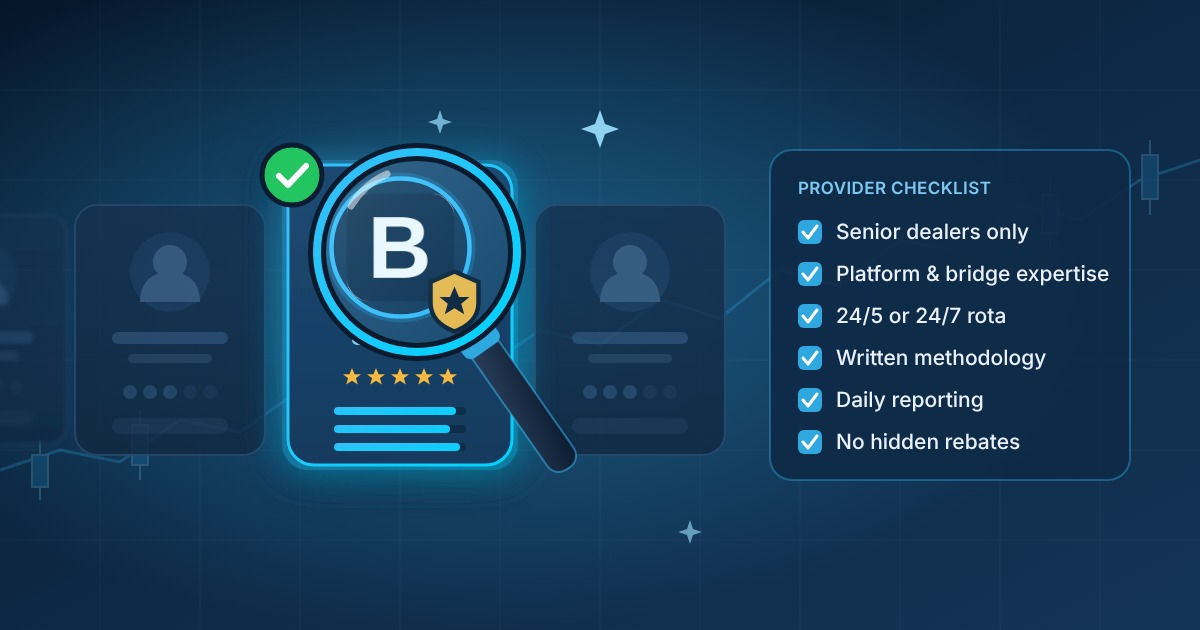
Choosing an outsourced dealing desk is much closer to hiring a head of dealing than to buying a piece of software. You are handing an external team one of the most sensitive functions in your brokerage - your exposure, your routing, your clients' trading activity - so the decision should rest on evidence of how the team actually operates, not on how good the sales presentation looks.
In short, before you sign with any provider you should insist on:
- Proven, hands-on dealing experience on your trading platforms and liquidity bridges
- Senior, experienced dealers watching your book - not trainees learning on your setup
- A risk methodology that exists as a written document
- A sample daily report you can review before signing
- The minimum level of access needed to do the job - ideally read-only
- Clear, scope-based pricing and a contract you can leave cleanly
- No hidden commercial incentive to change your existing infrastructure
The rest of this guide explains how to test each of these points, and what a weak answer usually sounds like.
Real Dealers or a Software Reseller?
"Outsourced dealing desk" is used to describe two very different services. One is a genuine dealing operation: experienced people who have run books, made routing calls under pressure and handled difficult nights in the market. The other is essentially a monitoring tool with a support team watching the alerts. Both can be useful, but only the first one can actually run your dealing desk.
The quickest way to tell them apart is to talk to them. Ask who exactly will be watching your book in the middle of the night, what their background is, and how they handled the last bridge outage that happened during a major data release. A real dealing team answers with specific situations and decisions. A reseller answers with a list of features.
It also helps to describe a real problem and see what they offer. Mention a gap in your coverage hours, and a reseller will try to sell you another software licence, while a dealing team will propose how to staff it. Mention toxic flow, and a reseller will show you a filter on a dashboard, while a dealing team will start asking about your routing rules, how often clients are reclassified and how your bridge is configured - because that is usually where the problem sits.
Who Is Actually Watching Your Book? Senior Dealers vs Junior Rotas
Many outsourced dealing desks advertise that a team of four to six dealers is looking after your platforms around the clock. It sounds reassuring - but the headcount says very little on its own. In practice, a large part of such a rota is often made up of junior dealers who are still learning the job. Their role is to watch the screens and escalate to a senior colleague when something goes wrong.
That model has a real cost for the broker. When a price feed freezes during a major release, a bridge stops routing or a group of accounts starts exploiting a latency gap, the minutes it takes to recognise the problem, escalate it and wait for a senior dealer to respond are exactly the minutes in which the losses build up. And every night shift covered by a trainee means someone is learning on your book.
So ask every provider directly:
- How many of the dealers on my rota are senior, and how many years of live dealing experience does each of them have?
- Which brokers and prop firms have they worked for, and under which regulators?
- Who is actually on shift at night and at weekends, and are they authorised to act immediately or only to escalate?
- How long does it take, in practice, from an alert to a decision?
A provider that runs a genuinely senior team will answer these questions without hesitation.
Proven Expertise on Your Platforms and Bridges
Every provider claims to support every platform. What matters is how deeply they know yours. If you run MetaTrader 5, ask which Manager and Administrator functions the team uses every day and how they consolidate group-level exposure across several servers. If you run cTrader, Match-Trader or another back office, ask the same questions about that platform. A team that is strong on one platform but new to yours will learn on your book.
The liquidity bridge is where gaps in experience show up fastest. Whether you run oneZero, PrimeXM, Tools for Brokers, Centroid or another bridge, ask how the team would spot a configuration that has quietly drifted from its intended settings. A credible answer talks about configuration exports, a documented reference setup and execution benchmarks to compare against. A weak answer simply mentions "the dashboard".
What "24/5" Really Means: Coverage and Escalation
Ask the provider to describe coverage in hours and people, not adjectives. A team that works European hours and keeps a phone on overnight is not providing 24/5 coverage - it is providing daytime coverage with an emergency number. Genuine coverage looks like a rota with named shifts, structured handovers between them and a clear escalation matrix that defines who is contacted, in what order, for which kind of event.
If your product range includes crypto CFDs or other instruments that trade at weekends, check whether the provider can extend coverage to 24/7, and how weekend shifts are staffed.
Then ask a harder question: when was the escalation process last used, and what happened? Any desk that has been operating for a while has been tested. If a provider cannot describe an escalation that went well - or one that went wrong and led to a change in procedure - it probably has not been running long enough to be trusted with your book.
A Written Risk Methodology
A serious provider can hand you its risk methodology as a document. It should explain how exposure limits are set and reviewed, how A-book and B-book routing decisions are made and recorded, how toxic flow is identified and scored, and what separates an escalation from a routine adjustment. It does not need to be long - but it does need to exist, and your own risk policy should fit into it.
Be cautious with providers whose methodology comes down to "trust our experience". The whole value of an outsourced desk is the consistent application of rules you have agreed together. A desk that improvises is a risk you cannot audit.
Reporting and Transparency
Ask for a sample daily report before you sign. A useful report shows exposure snapshots, the actions the desk took, the issues it escalated and anything it noticed but decided not to act on. If the sample is just a dashboard screenshot, that is exactly what you will receive every day - numbers without any judgement behind them.
During the evaluation, pick one incident from the sample period and ask the provider to walk you through it: what they saw, what they did, who they informed and what changed afterwards. This conversation tells you more about how the team works than any brochure, because it shows whether the reporting is a genuine record of decisions or a document produced for the client.
Transparency also means access to your own data. You should be able to see what the desk sees, in close to real time, without having to request it. A provider that can only offer a weekly PDF is asking you to trust it blindly with a critical function.
Access, Data Security and Partitioning
Give the provider only the access it genuinely needs. For monitoring and advisory work, read-only access is usually enough, and any request that comes close to client funds should end the conversation. Where the desk will make configuration changes on your behalf, agree in writing exactly which changes it is allowed to make, and make sure every action is logged.
Your data must also be kept separate from the provider's other clients: separate credentials, separate storage and no shared views. Ask how this separation is enforced technically, not just what the contract says. Ask too who inside the provider's team can see your data, whether that access is named and logged, and what happens to your data when the relationship ends. A provider that cannot answer quickly has not thought about it carefully enough.
Watch for Hidden Incentives: "Let's Change Your Infrastructure First"
This is one of the most common - and least discussed - issues in the outsourced dealing market. Some dealing desk and service providers open the relationship by recommending major changes to your setup: a new trading platform, a different CRM, a new liquidity bridge or a switch of liquidity provider. Sometimes these changes are genuinely needed. But brokers should be aware that technology and liquidity vendors often pay referral fees, revenue shares or volume-based rebates to the partners who introduce new clients to them.
That creates a conflict of interest. A provider that earns from your migration has a reason to recommend one, whether or not it is in your best interest - and the migration itself brings cost, operational risk and months of distraction for your team. Before acting on any recommendation to change infrastructure, ask the provider directly:
- Do you receive any referral fee, rebate or revenue share from the vendor or liquidity provider you are recommending?
- What specific problem will this change solve, and can it be fixed within our current setup instead?
- What will the migration cost us in fees, time and operational risk?
A trustworthy provider will answer openly and will be able to show you why the change is necessary before suggesting it.
Pricing, Contract Terms and Exit
Pricing should be based on scope and easy to understand. You should be able to see which elements drive the fee - for example the number of servers, symbols, client groups, bridge connections and coverage hours. If a quote looks unusually low, ask what is not included. For a view of how outsourced pricing compares with the full cost of an in-house team, see our article Outsourced Dealing Desk vs In-House: Which is Right for Your Brokerage?
The exit terms matter as much as the price. Look for a defined notice period, a written handover process covering credentials, reports and documentation, and no lock-in beyond what the onboarding effort genuinely justifies. An initial term of a few months is reasonable; multi-year commitments to a service you have not yet experienced are not. A provider that is confident in its work does not need to trap its clients.
Finally, check how errors are handled. Every desk makes a mistake eventually. A professional provider has a written incident process - prompt disclosure, a post-incident report and a change of procedure where the mistake exposed a weakness. If the contract says nothing about errors, or the provider claims they never happen, that tells you how the first real incident will be handled.
Red Flags at a Glance
- Requests for write access you have not agreed, or any access close to client funds
- No sample daily report available before signing
- Coverage described with adjectives instead of shifts, rotas and named people
- Unclear seniority or experience of the dealers who will actually watch your book - or a large rota made up mostly of junior dealers who can only escalate
- A risk methodology that only exists in a sales presentation
- Very low pricing with no clear scope behind it
- No written exit process, or reluctance to discuss one
- Recommending a new platform, CRM, bridge or liquidity provider early on, without disclosing any referral fees or rebates involved
- Guaranteed P&L results - a dealing desk controls processes, not market outcomes
How Broktinger Approaches It
At Broktinger we built our outsourced dealing desk around the principles in this guide. Our team brings more than 15 years of hands-on dealing experience across MetaTrader 4, MetaTrader 5, cTrader and Match-Trader, and provides 24/5 coverage as standard, with 24/7 coverage including weekends available. We can run your desk fully or work alongside your in-house dealers.
Only senior professionals work on your book. Broktinger provides only senior dealers and risk managers with more than five years of experience at regulated CFD brokers and reputable prop firms. Nobody on our team is learning on your setup: whoever is on shift has the experience and the authority to act immediately, at the moments when time matters most - not just to escalate the problem to someone else.
Most importantly, we work with your existing infrastructure. We do not start a relationship by proposing a new platform, CRM, bridge or liquidity provider. Our job is to make the setup you already have run better - tightening configurations, improving monitoring and closing coverage gaps. We only recommend changing a component if you ask us to, or if you decide a change is needed.
Our dealers also use the same monitoring tools we offer to brokers, including the Broktinger Risk Monitor, which brings quotes, exposure, revenue, abuse detection and alerts into a single view for the desk.
Frequently Asked Questions
Should we start with a trial or assessment period?
It is a good idea. A short, clearly scoped assessment lets both sides confirm the fit before a longer commitment: the provider documents your current setup and coverage gaps, and you see how the team works in practice before handing over your book.
Is a larger provider always the safer choice?
Not necessarily. A bigger team can make it easier to staff a full rota, but what really matters is who is assigned to your book, whether your platforms are core to their daily work and whether their reporting is genuine. If you are the smallest client of a large provider, you may get less attention than from a focused specialist.
How can we check a provider's platform experience?
Ask practical questions only an experienced dealer could answer - for example, how they manage exposure on swap-free accounts at rollover on MT5, how they compare bridge configurations, or what a daily report contains. Then ask for a sample report and a reference call with a broker on the same platform as you.
What contract length is reasonable?
An initial term of three to six months is common and reflects the real effort involved in onboarding. After that, a rolling monthly agreement with a defined notice period is standard. Be wary of multi-year lock-ins for a service you have not yet tried.
Can one provider cover both a brokerage and a prop firm?
Yes, as long as it has experience in both. The monitoring overlaps, but the objectives are different: a broker manages book exposure, while a prop firm enforces challenge rules and protects its payouts. Make sure the provider has a methodology for each, rather than one adapted for the other.
If you are evaluating outsourced dealing desk providers, book a free consultation with our team. We will look at your current setup as it is, and show you where it can be improved - without asking you to replace anything.
Related
Talk to a brokerage specialist
Whatever stage your brokerage is at, our team can help with the platform, liquidity, risk and reporting work behind it.
Book a Free Consultation