How to Properly Set and Manage PROP Firm Challenges - Straight from the Dealing Room
A prop firm challenge is two things at once: a product you sell to traders, and the first risk control protecting your funded capital. Every rule in your rulebook decides which trading behaviour makes it through to a payout - and every gap in the wording will eventually be found by a trader, usually before it is found by you.
We look at challenges from the dealing room: the place where rules meet live trade data, where breaches are investigated and where payout requests are approved or rejected. This guide shares what we have learned about setting challenge rules that hold up, monitoring them in real time, and validating payouts properly.
Three Lines of Defence
A well-run prop firm protects itself in three layers, and each one depends on the one before it:
- The rulebook - defines what is allowed. Clear, measurable rules stop most abuse before it starts, at almost no cost.
- Live monitoring - detects breaches while the account is trading, not weeks later.
- Payout validation - the final, detailed check before any money leaves the firm.
Many firms invest heavily in the last two layers and treat the rulebook as marketing copy. That is the wrong way round. A vague rule cannot be monitored automatically, and it cannot be defended when a trader disputes a rejected payout.
Step 1: Write Rules You Can Actually Enforce
Before a rule goes into your rulebook, ask one question: could a reviewer decide, using trade data alone, whether this rule was broken? If the answer depends on interpretation, traders will interpret it - in their favour. Rules that work in practice share five qualities:
- Measurable - defined in numbers, times and data points, not intentions.
- Published in advance - the trader agrees to them before the first trade.
- Complete - edge cases are answered in the rule itself, not by a support agent later.
- Clear on consequences - the rule says whether a breach affects the trade, the payout or the whole account.
- Versioned - every change has an effective date, and you know which version each account accepted.
Write rules for the behaviour you can measure, and make sure you can measure everything you prohibit. Copying another firm's rulebook without checking that your monitoring can detect each violation is one of the most common - and expensive - mistakes we see.
A Practical Example: A Funded-Account Rulebook
To make this concrete, here is the kind of rule set a modern two-step challenge might apply to a USD 100K funded account. The values are a realistic example taken from the market, not a recommendation - your own settings should reflect your pricing, your traders and your risk appetite.
| Rule | Example setting | Why it matters |
|---|---|---|
| Daily loss limit | 5%, open trades included | Caps the damage from a single bad day |
| Maximum loss | 10% static (USD 90K floor) | Simple, objective and easy to defend |
| Maximum risk per asset | 5% | Stops all-in bets on a single instrument |
| Stop-loss placement | Within 5 minutes of entry | Forces defined risk on every trade |
| Minimum trade duration | 2 minutes | Filters out latency and tick-scalping strategies |
| News trading | Directional trades allowed, within defined rules | Allows genuine trading, blocks straddles around releases |
| Weekend holding | Allowed as a paid add-on | Gap risk is priced, not ignored |
| EAs and copying | Manual trading only; no automatic copying | Stops copy rings and purchased strategies |
| Leverage | 1:100 | Limits position size relative to the account |
| Prohibited practices | Martingale, grid, hedging across accounts, HFT, latency arbitrage, exploiting errors, reckless one-sided exposure | Removes strategies that exploit the model rather than the market |
| Negative risk-reward | Breach if 60% or more of trades risk more than they make | Catches "risk big, win small" gambling |
| Account rules | No sharing or reselling, no moving risk between accounts, no churning, capped total capital per trader | Closes multi-account loopholes |
| Inactivity | 30 calendar days | Keeps dormant accounts from sitting on allocated capital |
| Qualifying profit days | 4 days | Prevents one lucky day from producing a payout |
| Payout timing | First and later payouts every 14 days | Gives time for review and limits hit-and-run withdrawals |
| Profit split | 80% to the trader, with a minimum payout amount | Commercial term - but must be stated precisely |
Notice that every line can be checked against trade data. That is the standard every rule should meet.
Getting the Core Risk Rules Right
Drawdown and daily loss
A static maximum loss measured from the initial balance is the easiest to enforce and explain. Trailing drawdown can be commercially attractive, but you must state exactly what it trails - closed balance, peak equity or end-of-day equity - because each version produces different behaviour and a different number of disputes.
For daily loss limits, define "the day": server midnight, a fixed UTC time or a rolling 24 hours. Then answer the edge cases in the rule text: are floating losses included, are commissions and swaps counted, and how is a position that spans the reset treated?
Consistency
Consistency rules stop traders from passing on one outsized day. They only work if the calculation is published exactly - for example, "the highest profit day must be below X% of total profit in the payout period, measured in server time, including commissions and swaps". A rule that simply says the firm "may review for consistency" will lose every dispute.
News, EAs and execution exploits
"No trading around major news" is unenforceable. "No opening or closing positions within two minutes before or after listed high-impact releases on the affected instruments" is enforceable - as long as you publish the calendar source and the instruments. The same applies to EAs and latency: banning every EA is hard to police, but banning specific, observable behaviour - such as sub-minute holds clustered around price updates - is both fair and defensible.
Network-Level Abuse Needs Network-Level Rules
The most costly prop firm abuse rarely happens on a single account. Copy-trading rings, hedging between accounts and groups buying many challenges to play the odds are attacks across a network of accounts, so the rules must work at that level too:
- Prohibit mirroring trades between accounts - your own, other traders' or accounts at other firms.
- Prohibit opposite positions across accounts under common control.
- Define "common control" in operational terms: shared IP addresses, devices, emails, payment methods or trading patterns.
- Make the pattern itself the violation, regardless of intent - proving intent is almost impossible.
Monitor Live - Don't Wait for the Payout Request
If rules are only checked when a trader asks to be paid, abusers learn that the evaluation stage is free. Continuous monitoring changes the economics: breaches are caught during the challenge, organised groups move on to softer targets, and payout reviews become shorter because most issues have already been dealt with.
On MT4 and MT5, the data is rich - deal times to the second, IP and device information, group settings and full tick history. But cross-account patterns such as copy rings and linked hedging cannot be seen in any single back office. They require trade data from all accounts to be brought together and analysed in real time, which is exactly what the Broktinger Risk Monitor does.
Payout Validation: Broktinger's 45-Check Framework
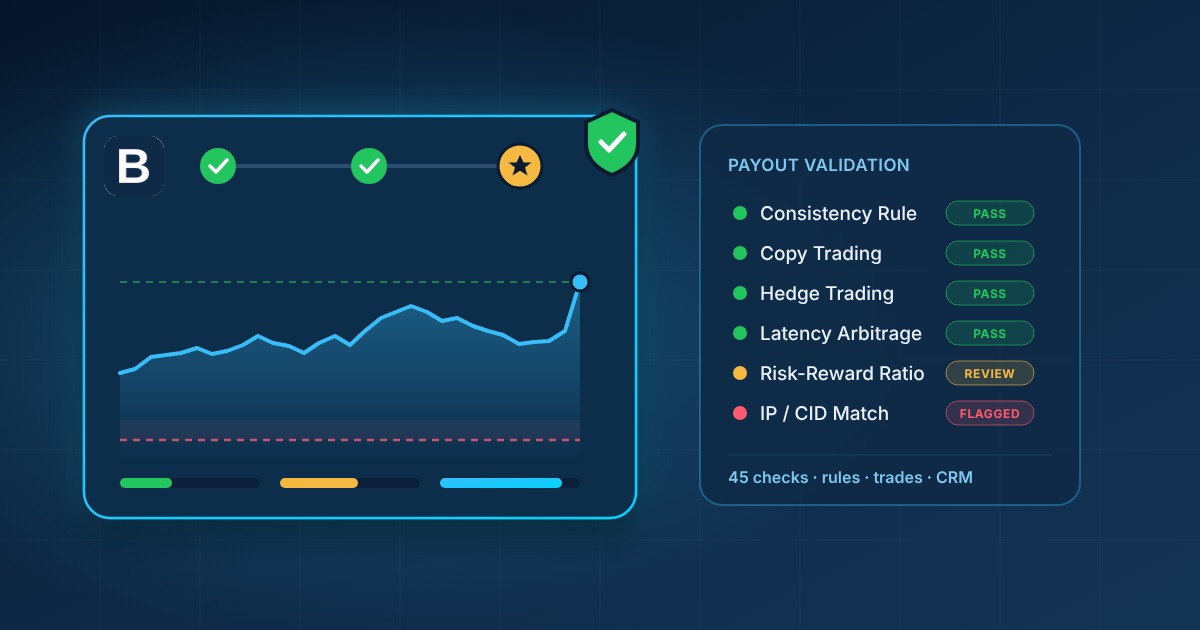
The payout review is where everything comes together. As part of our PROP trading management service, every payout request is validated against 45 checks, drawing on trade history, login journals, tick data, the economic calendar and the firm's CRM. The checks fall into seven groups:
| Check group | What is validated |
|---|---|
| Account linking | IP Match (including impossible-travel logins), CID / device match, Email Match, Related Abuse, Cross-Account Check for the same user, Total Capital of the User |
| Coordinated trading | Copy Trading, Cluster Trading, Hedge Trading (self and cross-account), Bracketing & Layering |
| Execution edge | Latency Arbitrage, Decay, Entry Edge, HFT, Scalping (including scalping between the same user's accounts) |
| Risk discipline | Risking Over %, Using Stop Loss, Risk-Reward Ratio, Increase of Risk After Loss, Adding in Drawdown, One-Side Bets, Abnormal Profits |
| Timing and holding | News & Market Open/Close (and rollover), Weekend Holding, Overnight Holding, Open Positions at Request |
| Activity and consistency | Minimum Trading Days, Excessive Trading Then Slow Down, Inactivity Period, Consistency Rule, Expert Advisor Trading |
| Payout history and CRM | Previous Payouts, First Payout After, Next Payout After, Blacklisted Before, Account Churning |
A Few Checks Worth Highlighting
- Impossible travel - the same user logging in from two cities too far apart to travel between in the time available, a strong sign of account sharing or passing.
- Related Abuse - flags an account only when two kinds of evidence point the same way: a link by IP, device or email and trading with or against the linked account. This keeps false positives low and decisions defensible.
- Cross-Account Check - combines all of a user's accounts that traded at the same time, so risk limits, drawdown averaging and risk after loss are measured across the whole group, not account by account.
- Excessive Trading Then Slow Down - spots "coasting": a few big days, then minimum-size trades placed only to tick off the required trading days.
- Decay and Entry Edge - measured on stored ticks, these show whether positions are in profit seconds after entry far more often than chance allows - the signature of an execution edge rather than market skill.
- Inactivity and Consistency - calculated exactly as the rules define them: calendar days between trades, profit days in server time, with commissions and swaps included - so the result matches the rulebook to the letter.
- Account Churning - many blown accounts that only risked the challenge fee, against one or two large wins - an all-or-nothing approach that turns the challenge into a lottery.
Each check is configurable to your own rulebook, and the outcome distinguishes between a warning, a profit deduction, a delayed payout and a full breach - so the decision reflects exactly what your rules say.
Handling Disputes and Rule Changes
Every rejected payout is a potential dispute, and the firms that resolve them quickly are the ones that can produce four things immediately: the rule, the version the trader accepted, the acceptance record and the trade evidence. A few practices make this much easier:
- Publish worked examples - an account that passes, one that breaches the daily loss and one that fails consistency. They reduce honest confusion and remove the "I didn't understand" argument.
- Change rules prospectively only - new rules apply to new trades, with notice and fresh acceptance. Applying them retroactively destroys trust and loses disputes.
- Fix ambiguity for the next cohort - if a rule turned out to be unclear, decide the current case on the published text and improve the wording going forward.
- Make phase differences explicit - evaluation and funded rules may differ, but each phase needs its own complete, published rule set.
How Broktinger Supports Prop Firms
Broktinger helps prop firms at every stage: designing and reviewing challenge rules so they can actually be enforced, configuring them on your MT4 or MT5 servers, monitoring accounts in real time with the Risk Monitor, and validating every payout against our 45-check framework.
The work is done by senior dealers and risk managers with years of experience at regulated CFD brokers and reputable prop firms - people who know what abuse looks like in real trade data. And, as always, we work with your existing platform, CRM and infrastructure rather than asking you to replace them.
For a deeper look at the abuse patterns that reach both brokers and prop firms, see our guide to toxic flow and how to detect it.
Want to see how your current rulebook and payout process would hold up? Book a free consultation with our team.
Related
Talk to a brokerage specialist
Whatever stage your brokerage is at, our team can help with the platform, liquidity, risk and reporting work behind it.
Book a Free Consultation