AI in the Dealing Desk: Machine Intelligence vs Real-Time Experience
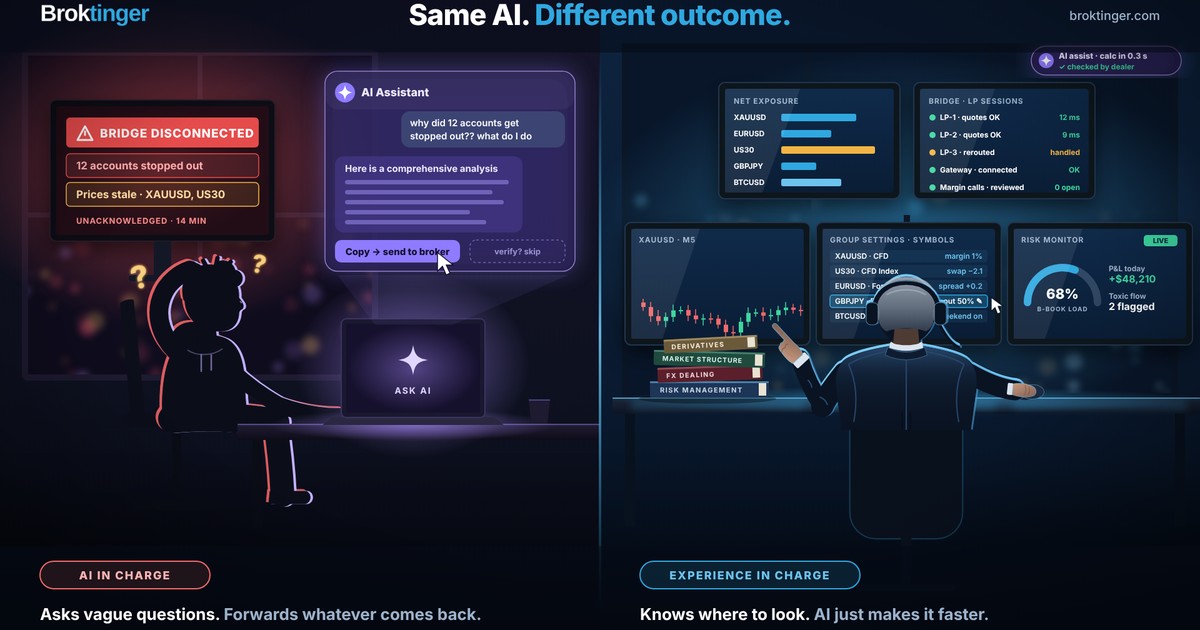
AI can write a dealing report in seconds. It cannot take responsibility for one. For FX and CFD brokers, that difference has become one of the most important questions to ask about any dealing desk, in-house or outsourced.
AI is part of everyday work across the industry nowadays. The question is not whether a desk uses AI. It is who uses it, how they use it and whether the people behind the desk could do the job without it, and whether they would notice when its answer is wrong.
The quiet shift inside many dealing desks
Many dealing desks now run a large part of their work through AI models. The pattern is usually the same.
Years ago, a senior dealer wrote the procedures, report templates and checking logic. Today those documents are loaded into a general-purpose AI model, together with client account data and trading platform configurations. The model then produces the trading-behaviour analysis, the spread and swap review, the group settings check or the bridge setup summary.
The person running that workflow often could not do the same work manually. They may not know where a setting sits in the MT5 Administrator, why it was configured that way for a particular client or group, or which log to open when something does not add up.
The output still looks impressive: well structured, confidently written and partly correct. But someone has to read it, check it, validate it and act on it, and on many desks nobody in the chain is qualified to do that.
Many providers advertise a large team of experienced professionals watching your servers and clients. In our experience, much of that team is junior staff with access to an AI model, the trading platform and your account data. Questions from broker management reach the dealing desk, then directly go into the model, and the model's answer goes back to the broker.
This is made worse by a simple fact: many brokerage managers do not come from a dealing background. When the desk sends a polished answer, it is accepted without challenge, because nobody on the broker's side knows which questions to ask next.
Using AI is one thing. Depending on it is another
There is nothing wrong with a dealer using AI to improve the structure and wording of a reply they have already written. The line is crossed when the model does the thinking, because the person asking does not know what they are actually checking.
| Task | Fine: AI as a tool | Red flag: AI as a substitute |
|---|---|---|
| Client reply or incident report | Polishing wording a dealer has already written | Asking the model what happened and forwarding its answer |
| Symbol and group settings | Speeding up a comparison the dealer knows how to read | Asking the model why a setting is configured that way |
| Trading-behaviour review | Faster calculation of metrics the dealer has defined | Uploading client data and asking for a verdict |
| Bridge or platform issue | Searching documentation faster | Asking the model where to look and what to change |
Incident investigations show the gap most clearly. A dealer who has handled the same kind of case before knows where the problem usually sits: a stale quote, a session setting, a bridge route, a margin call threshold on one group. A model asked "why did this happen?" does not know your setup either. It gives a general answer that sounds right and points nowhere specific.
That answer then reaches a manager who cannot tell the difference. The incident is closed on paper. The cause is still there.
The fundamentals reveal the gap
Experience shows first in the basics. You would be surprised how many self-described dealing specialists cannot confidently calculate simple figures like traded notional value or the profit per lot. Fewer still can explain how the result changes between MT5 calculation modes such as Forex, CFD, CFD Index, CFD Leverage and Futures.
These are not edge cases. They sit behind margin, commissions, swaps, hedging with liquidity providers and every revenue figure the broker reports. An AI model can produce the formula on request. Knowing which formula applies to which symbol, and recognising when an output is wrong, requires experience.
We have worked with regulated brokers whose revenue reports had been wrong for years. Nobody questioned them, because management assumed the people preparing them understood the calculations. Errors at this level do not stay internal:
| Stakeholder | What goes wrong |
|---|---|
| Regulators | Reported volumes, revenue and exposure that do not reconcile with the platform |
| Liquidity providers | Disputes over traded notional, commissions and hedged volumes |
| Retail clients | Incorrect margin, swaps or commissions, followed by complaints and lost trust |
In our experience, when a newly established brokerage closes within its first 12 to 18 months, a lack of clients is rarely the main reason. More often, the business trusted the wrong people with the operations that keep it compliant, profitable and credible.
Four risks of an AI-dependent dealing desk
1. Client data and credentials leave your control
To get an AI-generated behaviour analysis, someone has to upload client data: names, account numbers, trade histories and deposits. Sometimes manager credentials, bridge logins or server addresses are pasted in too, to give the model context.
Under GDPR, client personal data cannot be passed to a third-party AI service without a lawful basis, a data processing agreement and control over where it is stored. Credentials are an even bigger problem. A leaked server access or bridge login can become an entry point for unauthorised access or a DDoS attack on your trading infrastructure.
2. Selling experience you do not have
A provider that markets experienced dealers while staffing the desk with juniors who have never opened the MT5 Administrator is misrepresenting its service. The broker pays for professional judgement and receives a forwarded model output. That is not a grey area. It is unethical.
3. A polished report that answers nothing
An AI-written incident report usually has a summary, a timeline and recommended actions. Read it closely and it often has no root cause, no setting identified as the fault and no change that prevents a repeat. A broker needs a diagnosis, not a document.
4. Nobody acts
AI does not act on its own. It does what it is told, when it is told. If the instructions are wrong, incomplete or missing, nothing happens. So who spots the problem, who decides and who acts? On a desk without real experience, the honest answer is often: nobody, until a senior colleague is available.
24/7 coverage is not customer support
A person on shift with access to an AI model is customer support, not a dealing desk. That stays true even with the most advanced models and risk-monitoring solutions. Tools show you what is happening. Experience tells you what to do about it, and how fast.
The difference shows up in critical moments:
- The bridge drops. Which routes do you check, which LP sessions do you restart, and how do you protect open positions while prices are stale?
- Several accounts are liquidated at once. Is it a market gap, a pricing error, a margin setting or a coordinated strategy? Each needs a different response within minutes.
- A symbol behaves strangely for one client group. Why were its settings configured that way, and what breaks if you change them?
On an AI-dependent desk, each of these questions goes to the model first and comes back with a general answer. If a senior dealer is available, the issue is eventually resolved. If not, the broker waits, carrying market, financial and reputational risk in the meantime.
A dealer with 15 years on regulated desks has handled these situations in real time. A newcomer who learned FX from online tutorials, with a model open in another window, has not. Both can be called "on shift". Only one of them is actually covering your book.
Will AI replace dealers?
Give the same AI model to two people: a new dealer and a senior dealer with ten years on the desk. Who gets the better result?
The new dealer asks a vague question and gets a vague answer. The senior dealer asks a precise question about a specific setting, log or account, and can tell straight away whether the answer is right. In most cases the senior dealer does not need the model at all. The job is done manually or with a few spreadsheet calculations, because they know where the data is and what they are looking for.
AI amplifies the expertise of whoever is using it. It does not replace knowing what to ask.
Who would you want in the operating room?
Imagine you are about to go into surgery. Who do you want operating: a newly qualified doctor with an automated surgical robot, or a senior surgeon who has performed thousands of operations like yours?
The senior surgeon may use the robot too, for precision. The difference is that they know exactly what to do if it fails, or if something unexpected happens halfway through.
A brokerage is not life and death, but the logic is the same. A few small mistakes can start an avalanche: wrong prices, disputed stop-outs, client complaints, regulatory questions and reputational damage that takes years to repair. There is no room for trial and error, and testing AI models on a live broker's setup is not acceptable.
The real value of AI in dealing and risk management
Long before AI, dealers and risk managers ran sophisticated calculation models to investigate trading behaviour, find toxic flow and compare performance across clients, groups and periods. For longer periods or larger data sets, Excel was not enough, so the work moved to custom-built databases or expensive third-party software.
In every case, the calculations were designed by the dealers and risk managers using them. They decided what to measure, which data to use and how to read the result.
This is where AI adds real value today. It can help build software or calculation models that run those same computations in seconds instead of hours. But the logic still has to come from professionals. AI is not a magic tool that does everything from a simple "do it" request. If it is not told exactly what to calculate, on which data and how, it will still give you an answer. That answer will look well structured, and it will rarely be fully accurate.
Flying on autopilot
Think of a pilot in the 1990s. Aircraft had far less automation, so pilots were trained hard, in tough conditions, and were ready for any scenario, including the technology failing.
Today, pilots rely heavily on automation, autopilot and AI-assisted ground support. Are they as ready to act if that technology fails? If they were trained the same way, sure. However, if they learned to fly from a video tutorial, we would not bet on it.
Why Broktinger is different
Broktinger does not use AI-generated analyses, replies or calculations. Our team has been in the industry since the early days of MetaTrader 4, with more than 15 years behind regulated and off-shore dealing desks, including major and even catastrophic market events as they happened.
Where we use AI: inside our own tools, only to make them faster, more precise and more powerful, and to make the front end clearer. Every formula, calculation method, risk metric and fine-tuned setting in those tools was designed by experienced dealers and risk managers and validated against real data more than once before it went near a client's book. AI just makes it faster without corrupting accuracy or data security.
What we never do:
- Ask an AI what a client's problem is, why a setting is configured a certain way or what it means. That is guessing, not dealing.
- Load your clients' data into an AI model and ask it for a trading-behaviour analysis. Reading a trader's behaviour, understanding the figures and deciding the action is exactly what a broker pays a dealer for.
- Share your platform, bridge or server credentials with any AI service.
- Send you an answer our specialists could not have written without a model.
AI makes our specialists faster and sharper. It does not replace them.
Questions to ask before you hire
Before hiring a dealer, a risk manager or an outsourced team, every broker should ask: who do I want looking after my business, and what happens if I trust the wrong people?
These questions quickly show whether a desk runs on experience or on prompts:
- Do you use AI models to produce reports, analyses or replies to us? Which ones, and for what?
- Is any of our client data, or any platform or bridge credential, ever entered into an AI service?
- Can tonight's on-shift dealer find and explain a bridge mapping, group or symbol setting live, without a model?
- Walk us through a real incident you handled: where you looked first, and why.
- Can you explain, line by line, how our revenue report is calculated?
- When your most senior dealer is away, who makes the call, and how many years have they spent on a live desk?
You do not need seven people watching your desk if none of them really understands what is happening and they all depend on one senior colleague. You need a few real professionals who can manage several setups at once, because they have been doing exactly that for years.
Trust, experience and collaboration
At Broktinger we value three things: trust, experience and collaboration.
Trust is not granted. It is earned with proof, case by case. Earning it starts with experienced professionals who work closely with the broker and know what they are doing without asking a model.
In an era when everyone uses AI to make work easier, we still put real experience first. We do not reject AI. We know how to use it, and when not to.
If you want to know who is really behind your dealing desk, talk to our desk.
Related
Talk to a brokerage specialist
Whatever stage your brokerage is at, our team can help with the platform, liquidity, risk and reporting work behind it.
Book a Free Consultation