What Does an Outsourced Dealing Desk Actually Do?
In September, our CEO and co-founder Alex Hristov sat down with Sam Low, Founder and CEO of LiquidityFinder, for an in-depth interview on what an outsourced dealing desk actually does. It was a great conversation - and the questions Sam asked are exactly the ones we hear from brokers every week. So we decided to turn the key points into this article. You can read the full interview on LiquidityFinder: What Does an Outsourced Dealing Desk Actually Do?
What Is an Outsourced Dealing Desk?
An outsourced dealing desk is a partnership between a broker and a team of professional dealers and risk managers. The broker hands over most of its day-to-day dealing and risk-management operations to that external team, and focuses its own people on growing the business.
The value is not simply having someone watch the trading platform. It is having professionals who have already spent years managing flow, execution, exposure, liquidity and risk across many brokerages - people who know what to monitor, what can go wrong and how to react when it does.
"It is about having professionals who know what to monitor, understand what could go wrong, and know how to react when something does." - Alex Hristov, Broktinger
Building that capability in-house means hiring several experienced dealers to cover the shifts, paying competitive salaries for scarce talent, training them on your setup and then living through the trial-and-error period before the team is fully effective. An outsourced desk removes most of that cost, time and operational risk, and gives you a team that is operational from day one.
What It Does Day to Day
The first week: a full review of your setup
When a broker signs with Broktinger, the first job is a thorough review of the entire setup - from the smallest trading-platform settings through execution rules, bridge mappings and feed supervision, all the way to LP execution. We identify the weak points, explain what is causing each problem and how we recommend fixing it. Once the broker confirms how each issue should be handled, we make the changes and optimise the setup.
After that: continuous monitoring and optimisation
From there the desk moves into ongoing monitoring - work the broker may have been doing itself, or believed it was doing:
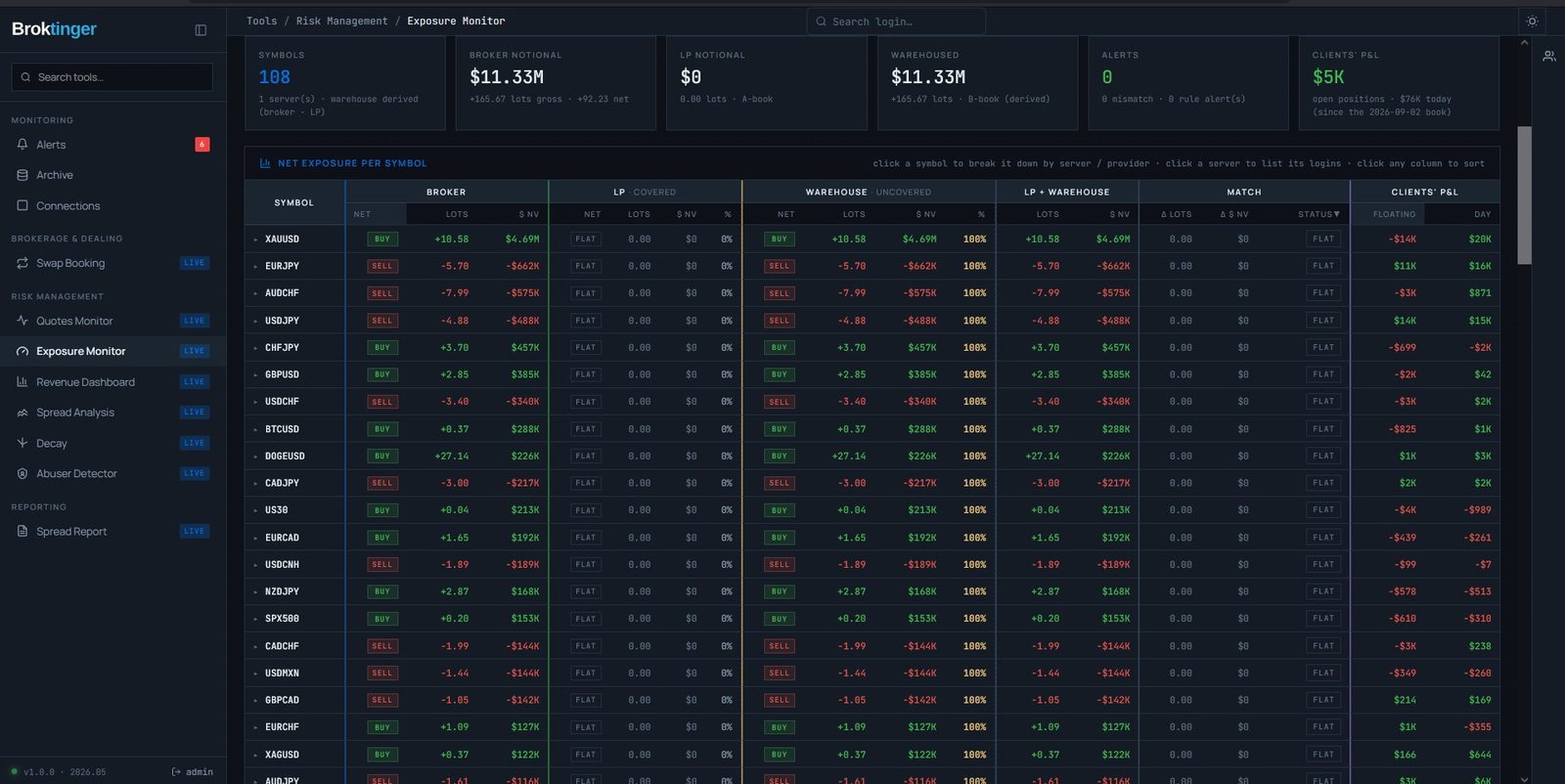
- Real-time exposure monitoring - so no exposure is ever left uncovered
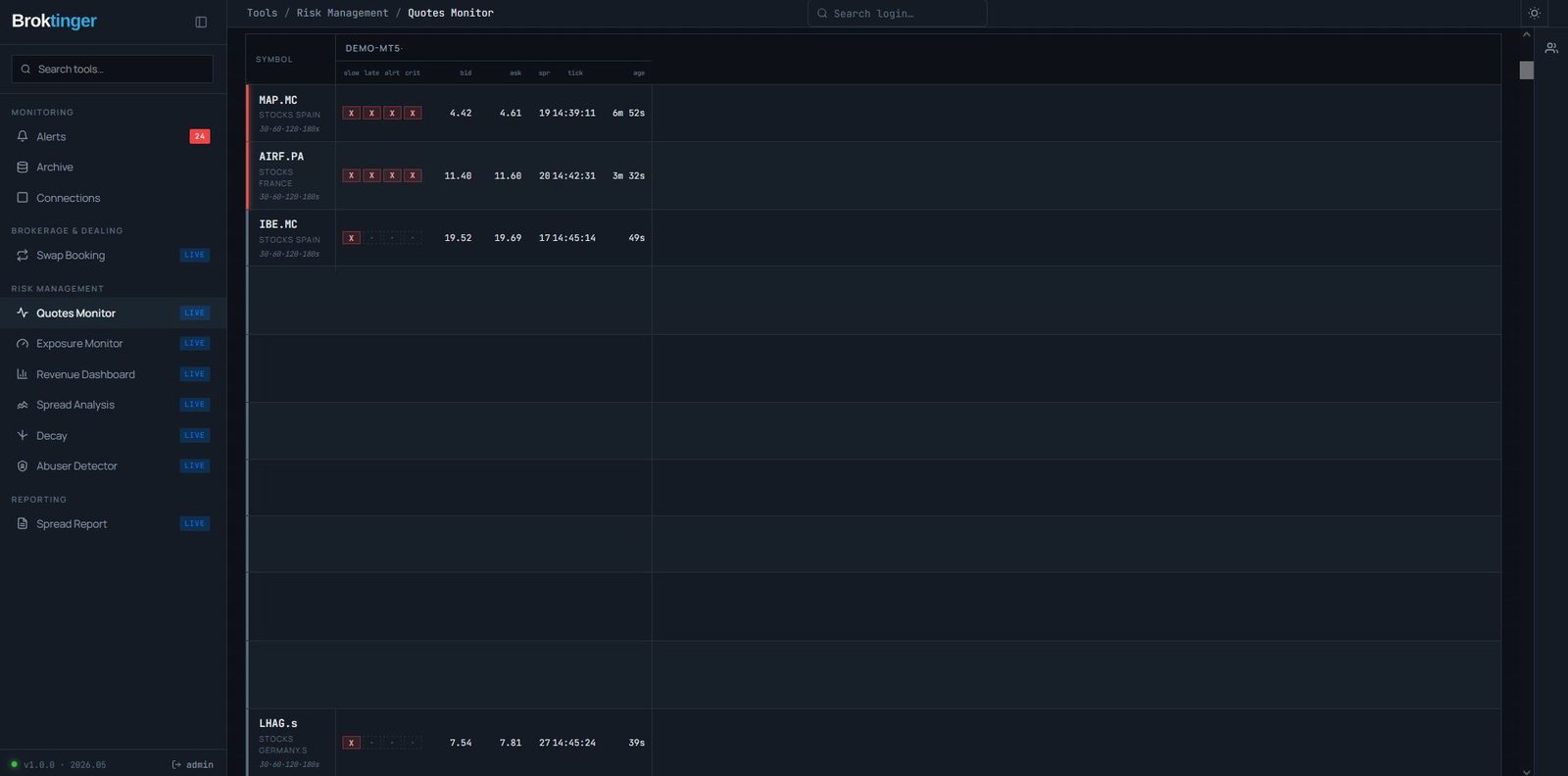
- Feed and quote monitoring - so no symbol is left without pricing for an unexplained reason
- Execution monitoring - so no orders get stuck in the queue and execution keeps meeting best-execution standards
- Flow and book monitoring - watching how client trading behaves across the book
- Client profiling - identifying toxic flow and abusive patterns in time, and profiling clients so the broker can decide whether each one should be STP'd, B-booked or C-booked
A dealing service is never something you set up once and leave. Brokers constantly launch new products, adjust execution and onboard new LPs, and every change needs experienced eyes asking one question in advance: what could go wrong? Many brokers only ask it after something has already happened. We ask it before.
What Coverage Looks Like
Coverage is agreed with each broker and can be arranged as 9/5, 24/5, 24/7 or dedicated weekend coverage. Depending on the scope, one, two, three or more dealers cover the desk, so the agreed hours are always properly staffed.
The team pays particular attention to the moments that matter most: market opens and closes, and major economic releases such as Non-Farm Payrolls. These windows bring higher volatility and a greater chance of execution issues, pricing problems, liquidity changes and abusive trading. The goal is not just to have someone sitting at the desk, but to have the right level of supervision when the market actually needs it.
What Stays with the Broker
Broktinger can cover the brokerage's dealing and risk-management operations in full. That frees the broker's own team for the areas where it adds the most value: business development, payments, marketing, client acquisition and retention, and expansion into new markets.
The broker stays in control of the decisions that matter. We explain every issue we find and recommend how to handle it, but the final decision always remains with the broker. The aim is not just to take work away from the broker's team, but to put the specialist operational responsibilities - dealing, risk management, platform operations and execution - in the hands of people who do this every day.
Your Existing LPs and Infrastructure Stay as They Are
A question every broker asks is what happens to their existing liquidity providers and technology. The answer is simple: everything stays as it is unless you decide to change it. We do not bring in our own LPs, bridge providers or CRMs, and we do not try to convince brokers to replace their infrastructure. Our job is to optimise what is already there. If you ask for advice or a recommendation, we will give it - but only if you ask.
Some providers in the market push their own partners in order to earn rebates on traded volume or a share of profit. That is strongly against our policies and the way we work.
Who It Suits - and the Mistakes It Prevents
An outsourced dealing desk is usually the best fit for start-up, small and mid-sized brokers. Many come to us after trying to run the desk themselves, or after someone inexperienced did it for them - which cost them money, time and reputation.
Alex has been behind a dealing desk for seven years, and some of our dealers have more than 15 years of experience. The most common mistakes they see when brokers run the desk in-house include:
- Treating a brokerage like any other business, when its operational side is highly specialised
- Launching on a standard template from the platform provider, or relying on an inexperienced dealer
- Over-complicating the setup - onboarding large numbers of symbols, several LPs or many group types that are never used, which adds cost and risk
- Underestimating the thousands of small operational details that keep a brokerage running smoothly
"I often compare running a brokerage to owning a private jet. You can buy the aircraft and fill it with passengers, but without an experienced pilot, the plane may never leave the ground." - Alex Hristov
For brand-new brokers that need to launch quickly, an experienced external team can deliver a fully functional and tested trading environment, ready for real clients, within days rather than months.
The Tools Behind the Desk
Broktinger builds tools by dealers, for dealers. Everything we offer is something we use ourselves on our own desk - built because it solved a real operational problem, not because we wanted another subscription to sell. Alongside general brokerage tools such as the Swap Changer, Holiday Setter, Spread Report, Dividend Allocator and Balance Processor, our dealers rely on the Broktinger Risk Monitor:
| Component | What it does |
|---|---|
| Exposure Monitor | Live net exposure per symbol across broker, LP and warehouse, with instant alerts on mismatches or uncovered positions |
| Quotes Monitor | Watches every quote the platform receives and alerts on delayed or missing prices, allowing for holidays and session breaks |
| Spread Analysis | Compares spreads between feeds and servers, flags delays, negative quotes and slow feeds, and lets you replay events to the second |
| Decay Analysis | Examines P&L before and after every execution to expose traders who are consistently in profit straight after the fill |
| Revenue Dashboard | Realised and floating P&L, swaps, commissions, fees, volumes, top clients and symbols, and current and historical NOP |
| Abuser Detector | Scans history and live trading for abusive strategies such as latency arbitrage, HFT, scalping, insider activity and CID or IP matching |
| Alerts | Every component can raise real-time warning and critical alerts in one place |
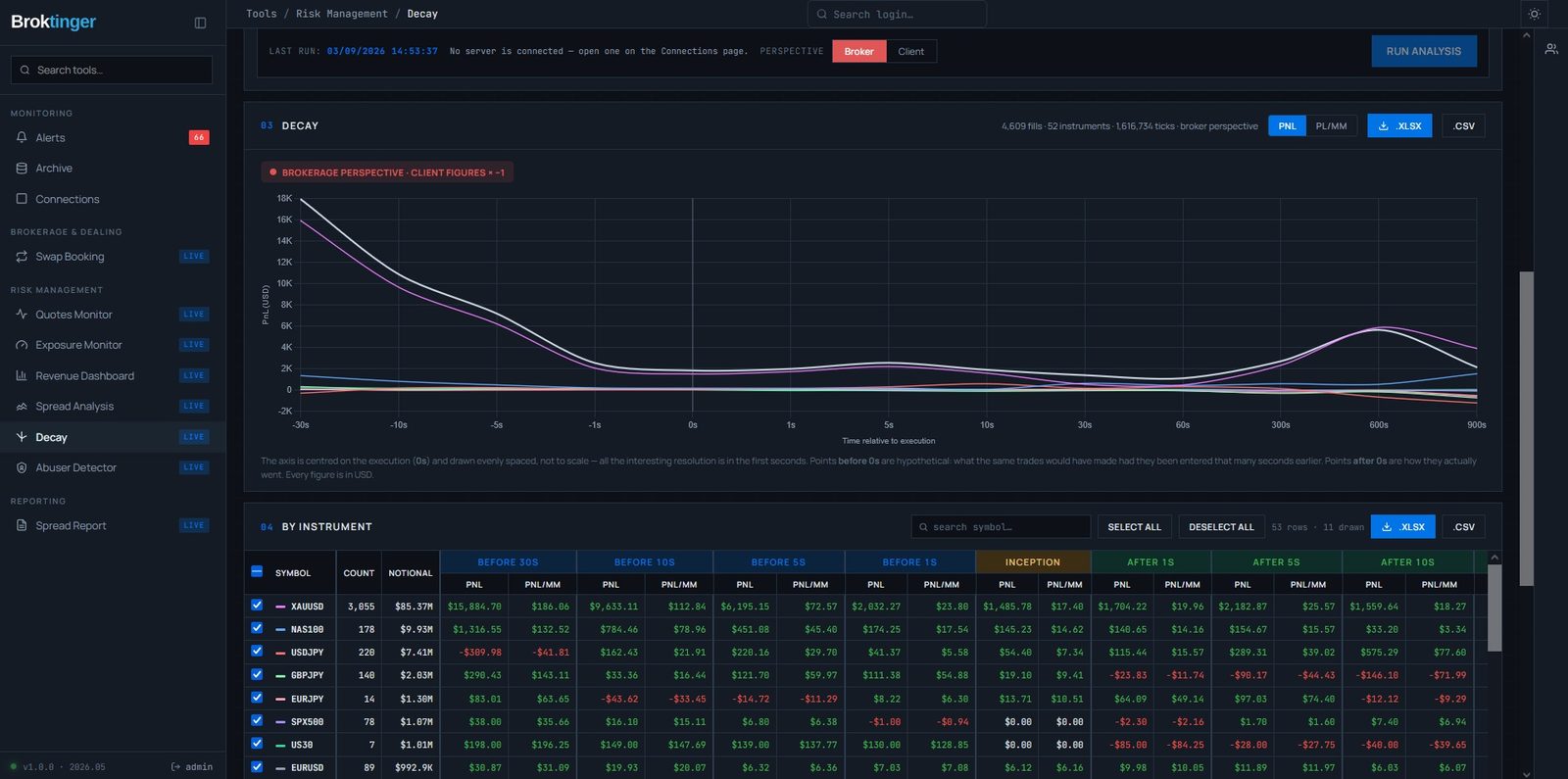
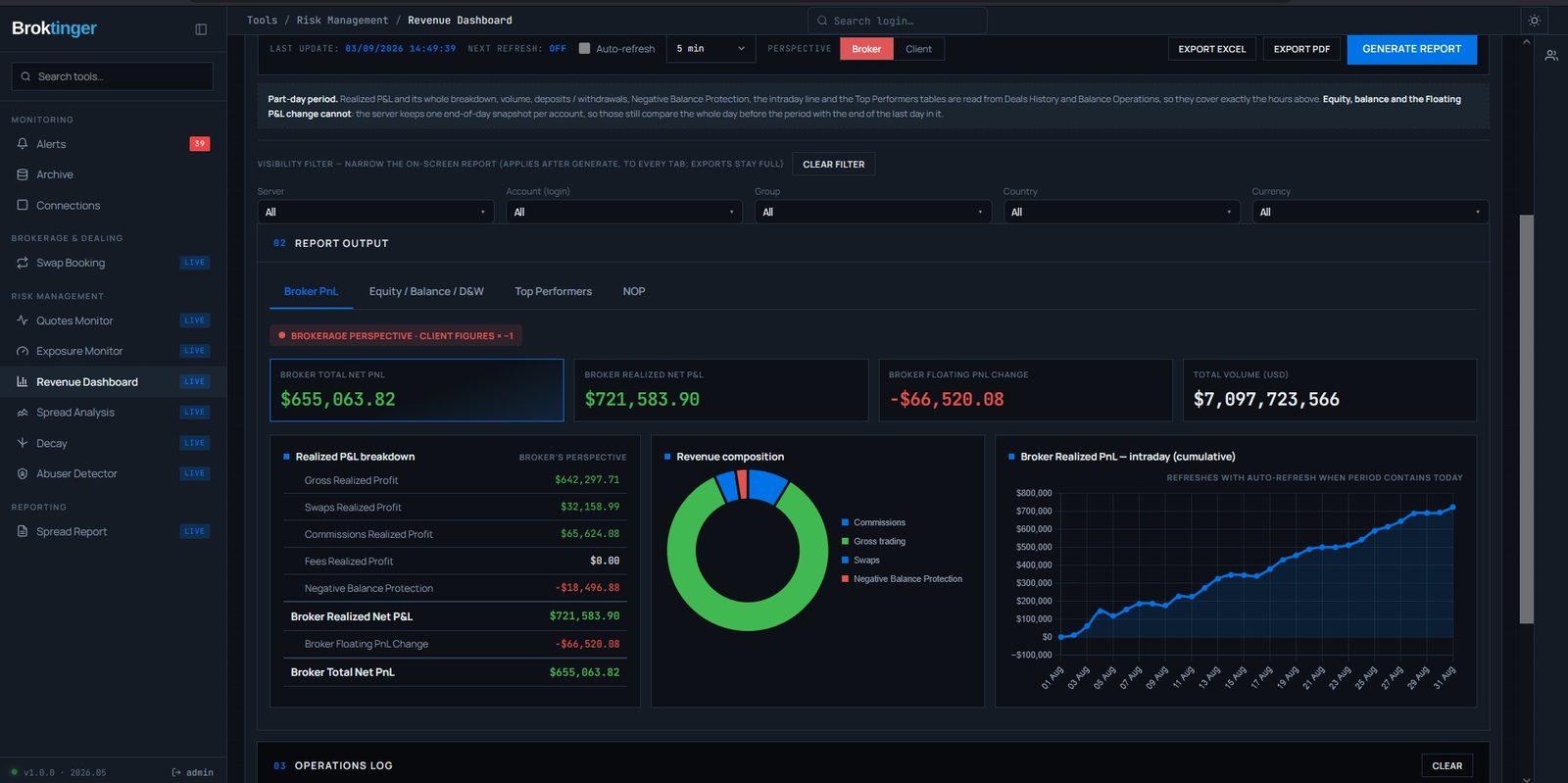
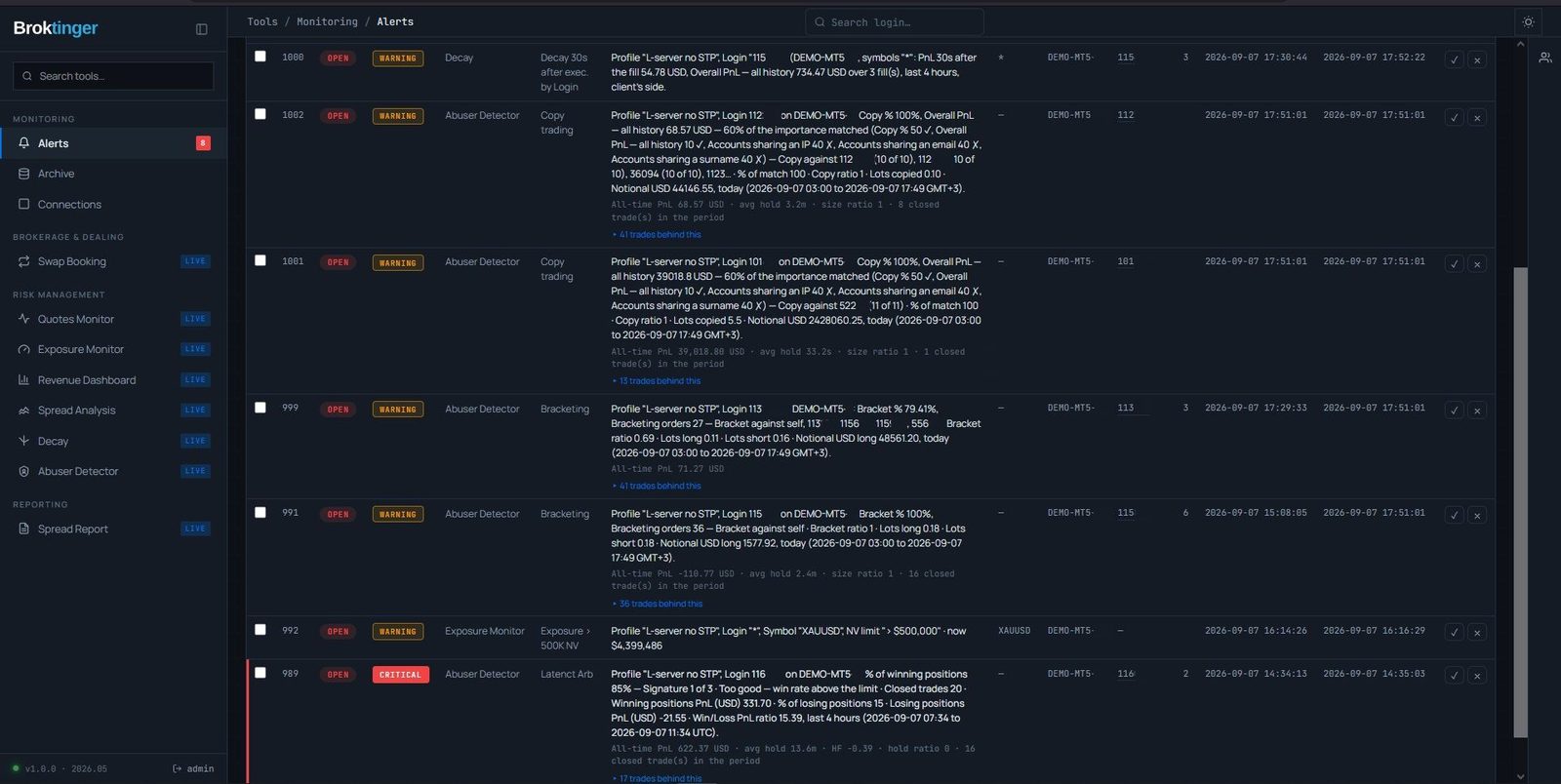
The key advantage over a platform's own reports is consolidation. MT5 offers plenty of server reports, but they are not designed to be read at a glance and often need exporting and extra calculation. The Risk Monitor connects to multiple MT5 servers at once and presents one clear picture across the brokerage. Nobody can effectively watch four screens, ten dashboards and several server reports at the same time - and there is no reason to, when one system can monitor everything continuously and alert you when something needs attention. The goal is not to replace the dealer, but to give the dealer the right information at the right moment.
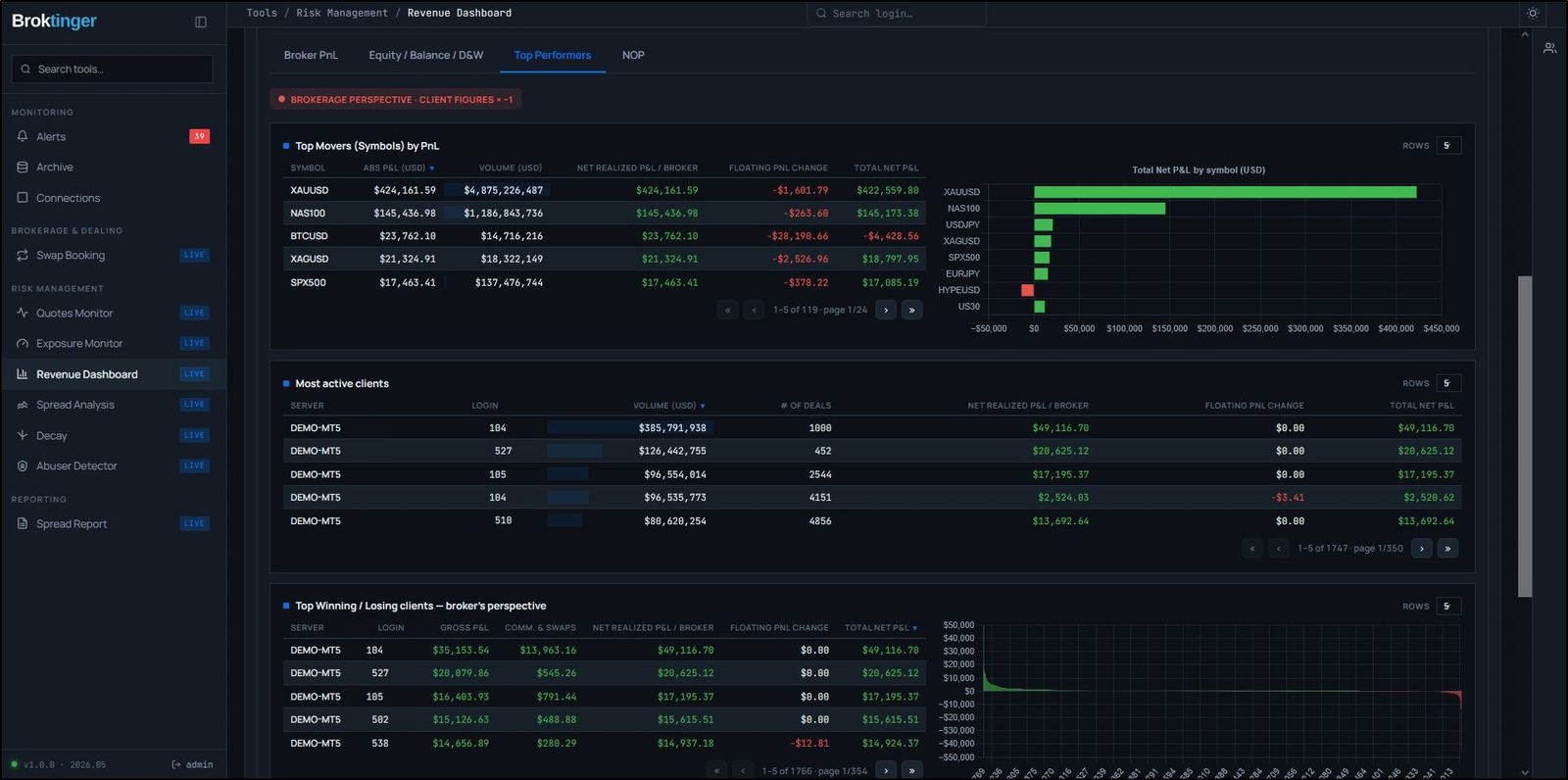
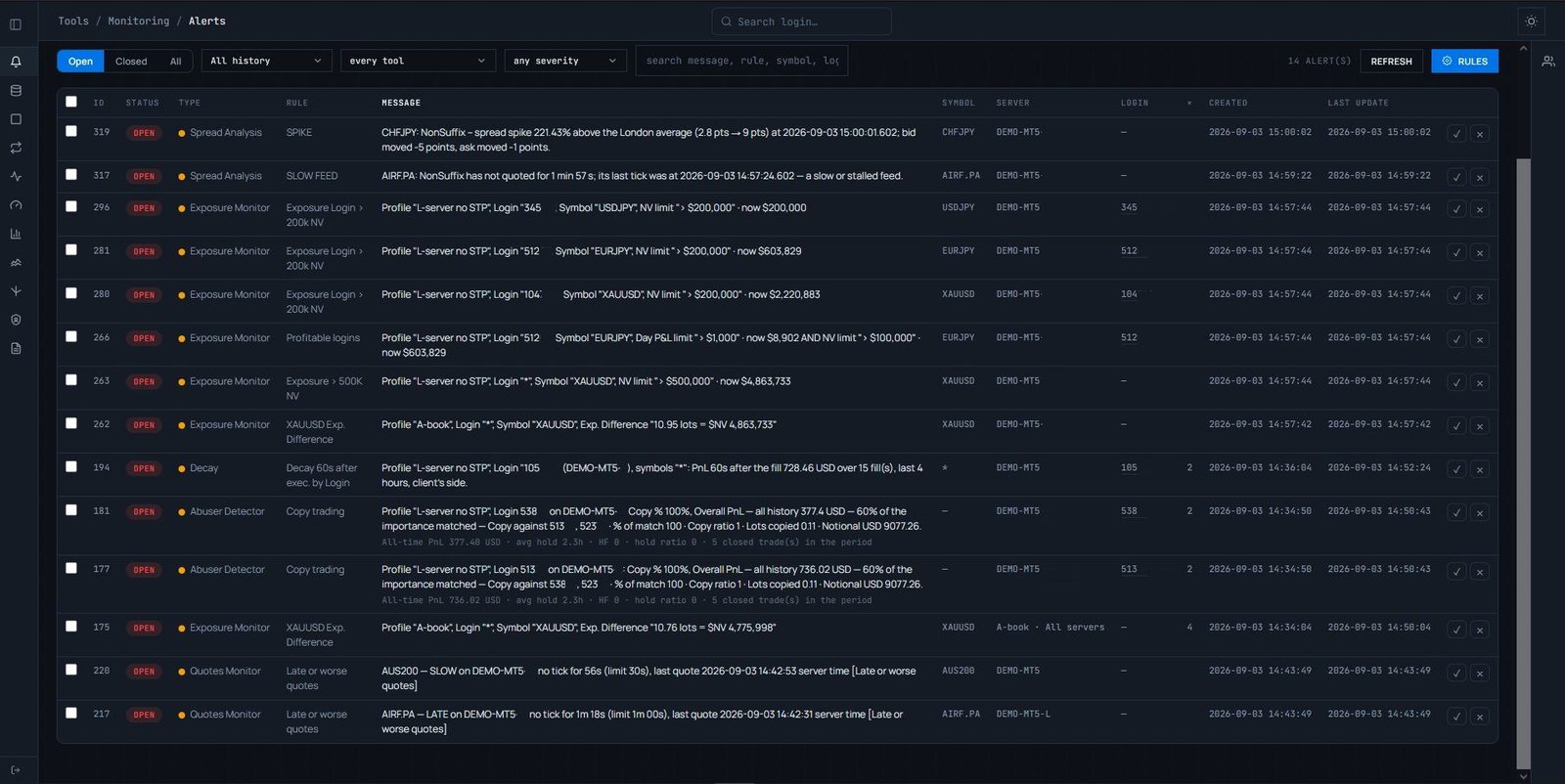
Every tool comes with a free testing period of two weeks to one month, depending on the tool. If you do not like it, you do not pay for it.
How the Commercial Arrangement Works
Every arrangement is tailored to the broker. We start by understanding exactly what you need, and after several discussions and a detailed assessment we recommend what the service should include - the final decision stays with you. A few principles guide every agreement:
- No upselling - we do not sell brokers services they do not need or that would become an unnecessary financial burden
- Problems solved, not created - the scope is built around fixing what actually needs fixing
- Flexibility - our agreements include a flexible termination policy, so a client who is not satisfied can end the relationship
- Long-term fit - the arrangement has to work for both sides, rather than locking a broker into a service that is not delivering value
For a closer look at how the cost compares with building an internal team, see Outsourced Dealing Desk vs In-House.
What Has Changed in Dealing
The brokerage industry evolves quickly, and the last few years have changed the dealing room in three important ways:
- Automation and AI - traders increasingly use Expert Advisors and algorithmic bots, and AI has made it far easier to build and deploy a strategy, even with little development experience.
- The new prop model - many prop firms have moved from funding a few talented traders to challenge-based models with large numbers of smaller traders. It is a niche business that is hard to manage well, but highly profitable for both firm and traders when it is structured correctly. See our guide to setting and managing prop firm challenges.
- More sophisticated toxic flow - abusive behaviour has become harder to identify before the broker feels the consequences. Read more in Toxic Flow - What to Know?
Today, getting a licence and buying a platform, a bridge and an LP feed is the easier part. Launching smoothly, keeping clients for the long term and staying competitive without damaging margins or your reputation in the FX community is much harder - and that is where an experienced dealing team makes the difference.
Frequently Asked Questions
Is an outsourced dealing desk the same as a liquidity provider's risk service?
No. A liquidity provider manages the risk of the flow you send to it. An outsourced dealing desk works for you and manages your whole operation - exposure across all symbols and groups, routing between books and LPs, platform configuration, feed and execution quality, and abuse detection.
How much does an outsourced dealing desk cost?
Every arrangement is tailored to the scope you need, but it typically costs a fraction of building a comparable in-house team, while significantly reducing operational risk.
Will you work with our existing platform, bridge and LPs?
Yes. Everything you have in place stays as it is unless you decide to change it. We optimise your existing infrastructure rather than replacing it.
How quickly can you start?
The setup review starts as soon as you sign, and for new brokers we can have a fully functional, tested trading environment ready for real clients within days.
What if we are not satisfied?
Our agreements include a flexible termination policy, and our tools come with a free testing period - so you can judge the value for yourself before committing.
Our approach is built on trust, experience and collaboration: we run dealing and risk management as if it were our own business. If you would like to see what that looks like for your brokerage, book a free consultation - and if you have not yet, read Alex's full interview on LiquidityFinder.
Reference: Sam Low, "What Does an Outsourced Dealing Desk Actually Do?", LiquidityFinder, 9 September 2026 - interview with Alex Hristov, CEO & Co-founder of Broktinger.
Related
Talk to a brokerage specialist
Whatever stage your brokerage is at, our team can help with the platform, liquidity, risk and reporting work behind it.
Book a Free Consultation